Reading the Label: Full-Grain, Top-Grain and Genuine Leather
The words on a leather label tell you how a piece will age in your hands, once you know them. Full grain vs top grain vs genuine leather, plainly explained.
Few things in leathercraft cause as much confusion as the words printed on leather labels. Full grain, top grain, corrected grain, genuine leather, split, bonded: each sounds like a grade of quality, and some are used in ways that make them sound better than they are. Yet behind the vocabulary is a simple physical reality, the layers of a hide and what has been done to its surface, and once you picture it, every label becomes easy to read. That understanding pays off at the bench, because the grade of a leather decides how it cuts, how its edges finish and how it ages.
This article explains full grain vs top grain vs genuine leather, along with splits, bonded leather and the surface finishes you will meet in descriptions. It is part of our guide on how to choose leather for your projects, which also covers tannage, thickness and the parts of a hide.
The layers of a hide
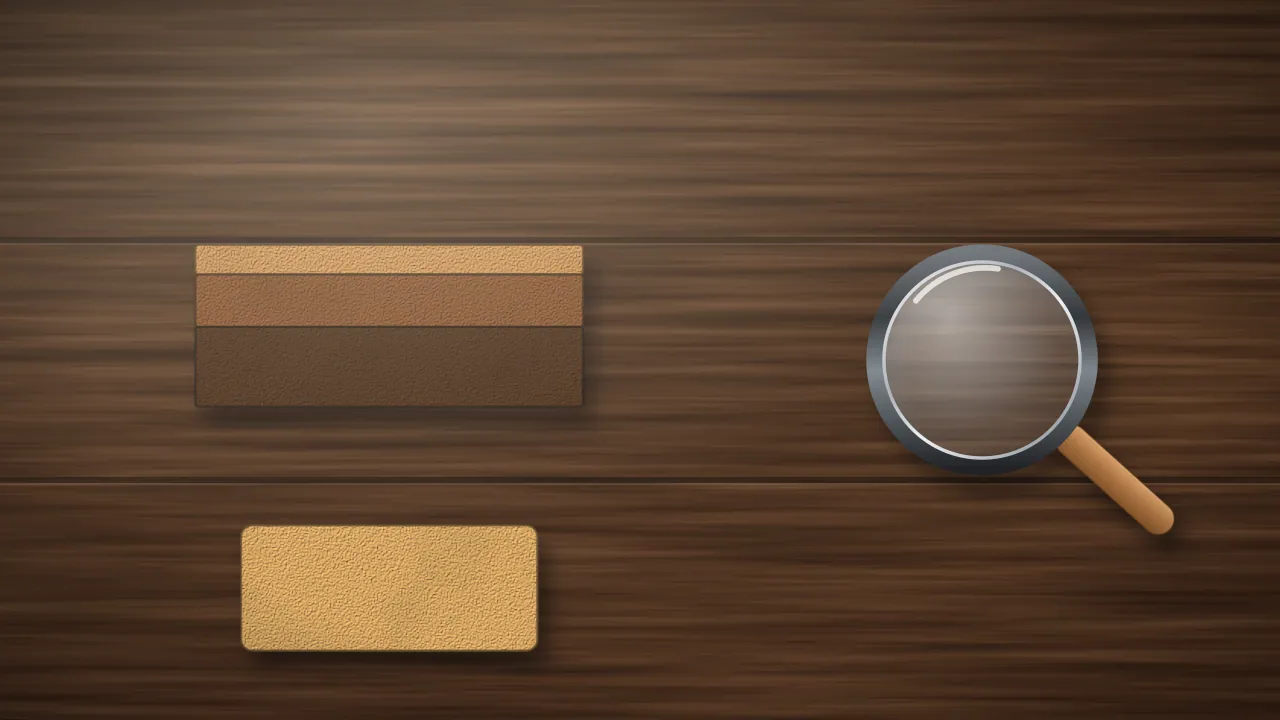
A hide is thick, and it is not the same all the way through. The outer layer, just below where the hair grew, is the grain: a dense, tightly woven network of fibres with a fine surface pattern of pores. Below it, the fibres become looser and more open, forming the corium. The underside, which faced the animal's body, is the flesh side.
Because a hide is usually thicker than most projects need, tanneries split it horizontally into layers. The top layer keeps the grain surface; the lower layers, without grain, are called splits. The top layer is generally the most valuable, because the dense grain fibres give strength, resistance to wear and the attractive surface that polishes and ages well.
What happens to that top layer next decides most of the labels. If its grain is left as nature made it, with only light finishing, it is full grain. If the grain is sanded or buffed to remove marks and then given a surface finish, it becomes what is often called top grain or corrected grain. The lower layers become splits, suede, or the base for coated leathers.
Full grain
Full-grain leather keeps its entire grain surface intact. Its natural marks, small scars, insect bites, growth wrinkles and variations in pore pattern, remain visible, which many makers and buyers see as part of its character rather than as flaws. Because nothing has been sanded away, its densest fibres are all there, which is why full grain is generally considered the most durable grade.
Full grain is also the leather that ages most visibly. Vegetable-tanned full grain in particular darkens and develops a soft sheen with light and handling, the patina described in patina explained. Its edges burnish well when it is vegetable-tanned, and it holds stitch holes cleanly. For hand-stitched goods meant to last, it is a common first choice.
The trade-off is that its surface shows everything: marks from use, scratches, water spots on unfinished leather. Some people love that record of use; others prefer a more protected surface. Full grain also tends to cost more than lower grades, because only clean areas of good hides can be sold with their grain untouched.
Top grain and corrected grain
The term top grain is used in different ways, which adds to the confusion. Broadly, it refers to leather from the top layer whose grain surface has been lightly sanded or buffed to remove imperfections, then finished with a coating or an embossed pattern to give an even look. You will also see this called corrected grain, especially when the surface has been significantly sanded and then embossed with an artificial grain pattern.
Corrected leathers have real advantages: a uniform appearance, good resistance to stains and marks thanks to their finish, and a lower price. They are widely used in furniture, shoes and mass-produced goods. For hand leatherwork, they behave differently from full grain: the surface coating may not take dye or burnish, the edges often need edge paint, and they age by wearing rather than by developing a patina.
Two related terms are worth knowing. Nubuck is top-grain leather whose surface has been lightly sanded to a velvety nap, soft to the touch and sensitive to marks. Embossed leather has a pattern pressed into it, sometimes imitating an exotic skin, sometimes simply an even grain.
Genuine, split and bonded leather
The phrase "genuine leather" is the most misunderstood label of all. Strictly, it only means the material is real leather rather than a synthetic. In practice, the phrase is often used for lower grades, frequently split leather from the lower layers of the hide, given a coated or printed surface to look like grain. Such leather can be serviceable, but it lacks the dense grain fibres, wears differently and does not finish at the edges like full grain.
Splits without a coating are used as suede when their surface is napped, and as linings and backing. Suede is soft and pleasant, but it stains easily and frays at the edges, so it is usually folded or bound rather than burnished. Splits with a heavy coating are sometimes sold as finished leather; look at the cut edge, where the open, fibrous structure of a split is easy to see beneath the coating.
Bonded leather is a different material altogether: leftover leather fibres shredded and held together with a binder, often with a coated surface. It is inexpensive but tends to peel and crack, and it does not stitch or finish like leather. Our comparison of leather and its alternatives looks at how it compares with synthetic and plant-based materials.
None of this means lower grades have no place at the bench. Splits make good linings, practice pieces and the inside of a pouch where nobody sees them, and suede can be lovely in a soft case. The point is to know what you are buying, to pay accordingly, and to use each grade where its qualities help rather than where its limits show. A clear description from a supplier, naming the layer, the tannage and the finish, is always a good sign.
Surface finishes: aniline, semi-aniline and pigmented
A second set of words describes the finish rather than the layer. Aniline leather is coloured with soluble dyes that soak into the fibres, without a pigment coating on top; it shows the natural grain and marks clearly and feels the most natural, but it is the most sensitive to stains. Semi-aniline adds a light pigmented or protective coat, which evens the colour a little and adds some protection while keeping a natural look.
Pigmented, or protected, leather has an opaque surface coating that gives a uniform colour and good resistance to stains and fading. It is practical and easy to care for, but it looks and feels less like bare leather, and its surface wears rather than ages. Many corrected-grain leathers are pigmented.
For the maker, these finishes affect dyeing, burnishing and gluing. Glue and dye do not penetrate a heavy coating, so surfaces to be glued are often roughened first. If you are unsure what you are holding, how to judge leather quality explains what to look for at the edge and on the surface.
Choosing grade by what you make
Full grain vs top grain vs genuine leather is ultimately a question of what you want from a piece. For hand-stitched goods meant to last and age, such as wallets, card holders and belts, full grain, often vegetable-tanned, is the natural choice; the differences in tannage are covered in vegetable-tanned vs chrome-tanned. For pieces where an even, resistant surface matters more than ageing, a corrected or pigmented leather can be sensible.
Read labels with the layers in mind, look at the cut edge and the surface, and ask suppliers when a description is vague. A small sample of each grade, cut, punched, stitched and finished side by side, will teach you more in an afternoon than any chart, and you will recognise each one by touch afterwards. Whatever grade you choose, the care you put into cutting, edges and stitching will show as much as the leather itself.
Questions people ask
Is full grain better than top grain?
For durability and ageing, full grain is generally preferred, because its dense grain fibres are intact and it develops a patina. Top grain, sanded and finished, gives a more uniform, stain-resistant surface at a lower price. Which is better depends on what you want the piece to do.
What does genuine leather really mean?
It means the material is real leather. In practice, the phrase is often used for lower grades, frequently split leather with a coated surface. It can be serviceable, but it does not wear, finish or age like full grain. Look at the cut edge and the surface to judge it.
Is suede full grain or split?
Suede is usually made from split leather, the lower layers of the hide, with its surface napped to a soft texture. Nubuck looks similar but is made from the grain side, lightly sanded. Both are soft and sensitive to stains and are rarely burnished at the edges.
How can I tell full-grain leather?
Look for natural pore patterns and small marks on the surface rather than a perfectly even, printed texture. At the cut edge, full grain shows a dense layer just below the surface. Unfinished full grain darkens quickly with a drop of water or a fingerprint of oil.
Is bonded leather real leather?
Bonded leather contains leather fibres, but they are shredded and held together with a binder, usually under a coated surface. It behaves more like a coated composite than like leather: it tends to peel and crack, and it does not stitch, finish or age like whole leather.